


How to sync Noom calorie tracking with your protein intake goals
Instead of adding up protein from memory after logging your meals, pair Noom calorie tracking with a label-based protein ledger so every food entry supports both goals. This workflow keeps your records aligned without depending on an automatic connection between apps.
TL;DR
- For Noom protein intake tracking, match calories and protein to the same food portion before reviewing daily totals.
- Use Noom for your calorie record and a simple protein ledger when your logging screen lacks the detail you need.
- Tigerfitness protein supplements are best for fitness enthusiasts filling a measured protein gap, not replacing a balanced diet.
- Verify serving sizes against packaging; a matching product name does not guarantee a matching nutrition entry.
Why this matters
A calorie total cannot tell you how much protein you ate. Protein contributes energy, but so do carbohydrates and fat; meeting your calorie goal does not automatically meet your protein goal.
Treat calories and protein as separate targets attached to the same meals. The job is to reconcile portions, not force the totals to mean the same thing.
Tigerfitness sells protein powders and snacks that you can include in this process. Supplements remain optional: count protein from meals first, then decide whether a convenient serving fills an actual gap.
For your 2026 setup, distinguish a manual reconciliation workflow from an automatic integration. The instructions below align your records through shared food names, portions, and dates; they do not require a connector or promise background data transfer.
Before you start
- Have access to your Noom account, your food-logging screen, and a notes document or spreadsheet for protein totals. Keep package nutrition labels or reliable food-composition information nearby.
- Write down your existing calorie and daily protein goals. If you need an individualized protein target, ask a registered dietitian rather than deriving one from a calorie allowance alone.
- Catch the serving-size mismatch before logging: grams of powder are not grams of protein, and a scoop is not automatically the labeled serving. Match the amount eaten to the nutrition information used.
Use the package in your hands as the reference for packaged foods. Flavor, formulation, and serving size must match the entry; a familiar name is not enough.
If tracking feels compulsive or conflicts with eating-disorder care, discuss a less numbers-focused approach with your clinician. This workflow is an organizational method, not a reason to tighten food restrictions.
Daily targets
- Open your Noom food record and identify the date you are logging. Keep your separate protein ledger on that same date, especially when entering a late meal the following morning.
- Create these ledger headings: Date, Food, Amount eaten, Calories, Protein, and Source. These are headings for your own record, not Noom menu labels.
- Record your established calorie and protein goals above the ledger. Keep calorie units and protein grams clearly separated.
- Choose the record you will use to judge each target: Noom for logged calories, and your verified protein total for protein intake. Do not add totals from both records together.
Expected result: you have a dated workspace with separate goals and an explicit source for each daily total.
Keep the protein goal stable unless your nutrition plan calls for a change. An exercise entry or a changed calorie allowance is not, by itself, an instruction to change your protein target.
For a repeatable 2026 routine, add a brief note explaining where the target came from, such as your dietitian's plan. That prevents a later adjustment from becoming an unexplained number you keep copying.
Food entries
- Open the food-logging function in your Noom account and find the food you actually ate. For packaged foods, compare the exact product and flavor with the package before selecting an entry.
- Check the serving basis. Determine whether the nutrition values describe a serving, a package, or a weight of food, then enter the amount you consumed.
- Compare the entry's calories with the corresponding package information. If the entry does not match, use an accurate entry or the food-entry tools available in your account rather than knowingly accepting incorrect values.
- Copy the same food and portion into your protein ledger. Record protein from the matching label or food-composition source, and identify that source.
- Include additions separately: milk, yogurt, nut butter, and other shake ingredients belong in both the calorie record and the protein calculation.
Expected result: each logged food has a corresponding protein amount based on the same portion.
For unlabelled foods, match the preparation state as well as the food name. A cooked-food entry and a raw-food weight are not interchangeable because cooking changes water content.
Do not estimate protein from calories alone. The standard nutrition-label conversion assigns protein 4 kcal per gram, but a food's total calories also include energy from its other components.
Protein ledger
- Multiply the label's protein per serving by the number of servings you ate. Apply the same serving multiplier to calories when checking your Noom entry.
- Add protein from all foods, not just foods marketed as high protein. Include the contributions from grains, dairy, legumes, and other meal ingredients.
- Subtract the protein total already eaten from your established daily target. Treat the result as a planning gap, not a demand to eat regardless of fullness or clinical advice.
- Compare any planned addition with the calories remaining in your food plan. A protein-containing food still contributes calories.
Expected result: your remaining protein amount reflects the meals already logged, and any planned addition is accounted for in both records.
Use this sequence each time you reconcile the day: Daily targets, Food entries, Protein ledger, then Daily review. Correct the underlying portion before changing either total.
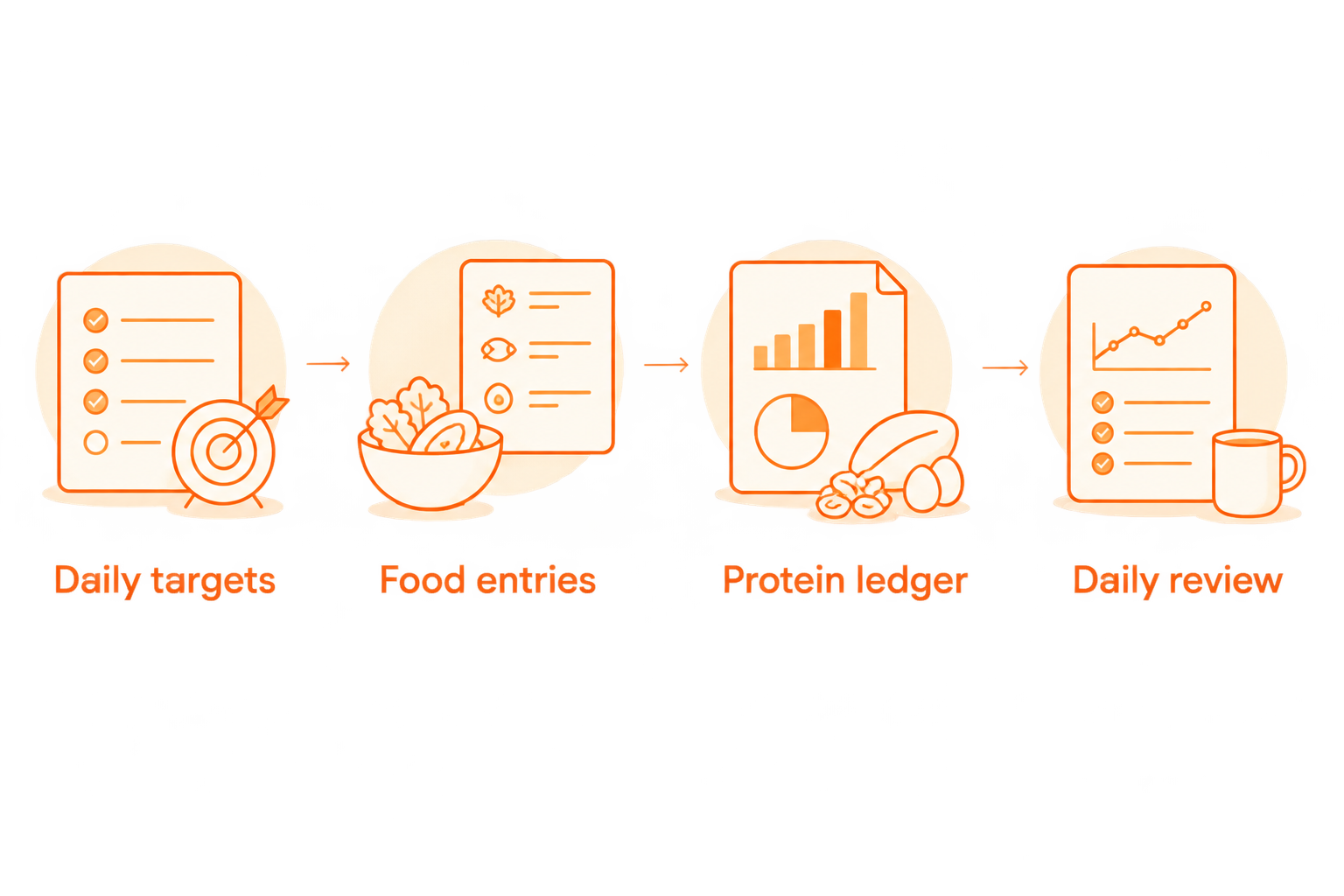
You do not need a supplement to complete the ledger. For Tigerfitness protein supplements, use the product's nutrition label exactly as you would use the label on any packaged food.
Daily review
- Compare the foods listed in Noom with the foods listed in your protein ledger. Look for missing snacks, drinks, shake ingredients, and portions changed after the original entry.
- Correct portion discrepancies in both places. Do not fix a protein shortfall by changing only the ledger while leaving the calorie entry untouched.
- Review the remaining protein gap alongside the rest of your meal plan. Choose a meal adjustment before automatically adding a shake or bar.
- Save a short note about any uncertain entry so you can resolve it from the package later. Keep an estimate identified as an estimate.
Expected result: the two records describe the same day's food, even though they track different goals.
Close the day by checking food entries, not by making the numbers look perfect. A precisely added total built from the wrong serving sizes is still wrong.
When reviewing your 2026 routine, distinguish a nutrition problem from a recording problem. Missing a drink in the ledger needs an entry correction; repeatedly missing your protein goal needs a meal-planning discussion.
Reconcile protein whenever a meal changes
The adjacent workflow is an update check: whenever you change a meal or portion, update its protein contribution at the same time. This is especially useful when you replace a planned lunch, split a packaged snack, or change a shake recipe.
- Portion change: adjust calories and protein using the same serving multiplier.
- Ingredient swap: remove the original ingredient before adding its replacement.
- Meal moved: move the corresponding protein entry to the same date as the calorie entry.
- Uneaten food: record the amount consumed rather than leaving the planned portion in place.
For vegetarian meals, boosting protein without supplements means planning protein-containing foods into the meal itself, then counting their full calorie contribution rather than treating protein as a separate add-on. Beans, lentils, tofu, dairy, and eggs can contribute, depending on your dietary pattern.
Best for meal planning: adjust the foods you already eat when a meal can accommodate the change. The advantage is that protein stays part of a meal; the limitation is that ingredient changes also alter its other nutrients and calories.
Best for convenience: use a packaged protein option when preparation or portability is the obstacle. The advantage is a stated serving basis; the limitation is that you still need to verify the label and fit the serving into your plan.
Packaged protein options for a measured gap
Tigerfitness offers both powders and bars, but format does not determine whether a product fits your goals. Compare the complete label, your dietary requirements, and the portion you intend to eat.
The supplied product descriptions state 20 grams of protein for Beverly International UMP Ultimate Muscle Protein and 20 grams for Nulla Gourmet Protein Bar with goBHB. Confirm the current package's serving basis before transferring either figure into your 2026 food record.
| Option | Best for | Practical advantage | Limitation |
|---|---|---|---|
| Beverly International UMP Ultimate Muscle Protein | People who want a milk protein powder | Powder lets you prepare a measured serving | Mixing ingredients require separate entries; milk protein does not fit a milk-free diet |
| Nulla Gourmet Protein Bar with goBHB | People who want a packaged bar | A bar avoids powder preparation | Eating part of the bar requires a portion adjustment; review the complete ingredient list |
Choose by the gap and the label, not by the biggest protein claim. Neither option is necessary when your normal meals already meet your target.
Packaged protein options

Milk protein powder with 20 grams of protein stated in the supplied product description.
$41.50

Chocolate Chip Crisp protein bar with 20 grams of protein and goBHB.
$3.99
Troubleshooting
The food name matches, but the nutrition does not
Compare flavor, serving weight, and package information. Replace the mismatched entry rather than adjusting your protein goal to compensate for an inaccurate food record.
The protein ledger looks right, but calories are missing
Check shake liquids, toppings, spreads, and partial servings. Protein-only notes do not replace calorie entries; each ingredient needs to appear in the appropriate record.
A shake appears twice
Check whether you entered a complete shake and then logged its powder or liquid again. Keep either a correctly calculated complete recipe or its individual ingredients, not both for the same consumed serving.
Your protein goal exceeds what fits your meal plan
Review the goal and the meal plan with a registered dietitian. Do not keep cutting other foods or lowering calories simply to force a self-selected protein number into place.
You cannot find the macro detail you expected
Continue with the label-based ledger instead of repeatedly searching for a setting. This manual method does not require a particular protein dashboard, menu name, or connection permission.
Customize your workflow
Keep a short list of frequently eaten foods with their verified serving basis and label source. Reuse the information only while the product and label still match; a saved entry is a shortcut, not permanent proof of accuracy.
Separate planned meals from eaten meals in your notes. Planning helps you distribute protein across the day, while the completed record needs to reflect actual intake.
For 2026 tracking, preserve the simplest workflow that answers your questions. If recording every ingredient creates more work than insight, ask your dietitian whether a meal-based checklist would meet your needs better.
FAQ
How do I sync Noom calorie tracking with my protein goal?
Match each Noom food entry with the same food and portion in a protein ledger, then review both daily totals. This is manual reconciliation, not an automatic app connection.
Can I track protein if my Noom screen does not show the detail I need?
Yes. Record protein from matching package labels or reliable food-composition information in a separate ledger, using the same portions as your calorie entries.
Should my protein goal rise whenever my calorie allowance changes?
Not automatically. Keep your established protein target unless your nutrition plan calls for a change; an updated calorie allowance alone does not define a new protein requirement.
Do I need protein powder to meet my Noom goals?
No. Count protein from your meals first, then consider powder only if it fits a measured gap and your dietary needs.
Why does my protein shake have more calories than its protein provides?
Protein is not necessarily the shake's only energy source. Carbohydrates, fat, and added ingredients also contribute calories, so use the complete nutrition information.
Is Tigerfitness connected to Noom for automatic food logging?
This guide does not establish an automatic connection between Tigerfitness and Noom. Log the food you consume and verify its portion against the package.
What should I do if tracking protein makes eating stressful?
Discuss the tracking routine with a registered dietitian or your treating clinician. A less detailed meal-based approach can be considered within your care plan rather than forcing stricter logging.
One last thing
A scoop measures powder, not protein. Keep serving weight and protein grams in separate columns, and you eliminate a basic mistake before it spreads through every repeated shake entry.
Nutrition needs are individual. Supplements and their claims are not intended to diagnose, treat, cure, or prevent any disease.
Leave a comment