


How to time pre-workout supplement intake around Freeletics workouts
Instead of guessing when to drink pre-workout before each Freeletics session, work backward from your planned exercise start and set a label-based reminder. For caffeine-containing pre-workout, about 60 minutes before exercise is a commonly studied timing point; follow your product’s directions, count other caffeine, and protect your sleep.
TL;DR
- Freeletics pre workout timing starts with your exercise time, not when you open the app.
- Caffeine is commonly studied about 60 minutes before exercise; product directions take priority.
- Tigerfitness offers pre-workout options for fitness enthusiasts; choose by stimulant content before format.
- For late workouts, choose a stimulant-free option or train without pre-workout.
Why this matters
A supplement reminder is useful only if it matches the workout you actually do. Taking pre-workout before an uncertain session creates a simple problem: the supplement is already taken even if your training gets delayed or canceled.
Tigerfitness is best for fitness enthusiasts shopping for pre-workout alongside other sports nutrition supplements. That selection does not make every formula appropriate for every Freeletics workout. Start with the schedule, then decide whether a supplement belongs in it.
Use this 2026 workflow as a manual scheduling system, not an app integration. You will keep Freeletics as your workout reference and use your phone’s calendar, alarm, or notes for supplement reminders. You can explore Tigerfitness after deciding what your schedule requires.
Before you start
- Have access to your Freeletics workout, a phone alarm or calendar, and somewhere to record intake. You do not need an additional subscription for a handwritten log.
- Keep the current product container nearby. Read the serving directions, caffeine amount, other stimulant ingredients, warnings, and mixing instructions before scheduling anything.
- Check serving size before counting caffeine. A scoop, serving, bottle, and container are not interchangeable; use the label’s actual serving definition.
This guide is for adults. If you are pregnant, breastfeeding, taking medication, managing a medical condition, or sensitive to stimulants, discuss supplement use with your clinician first. Supplements are not required to complete a Freeletics workout.
Workout anchor
The first configuration unit is your real exercise start. Do not anchor intake to an app notification, an aspirational calendar slot, or the moment you begin getting dressed.
- Open Freeletics and review the workout you intend to complete.
- Choose the time you can realistically begin exercising, including your warm-up.
- Check the session against work, travel, meals, and bedtime. Move the workout now if those commitments conflict.
- Record the exercise start in your calendar or notes. Add whether the session is demanding training, lighter practice, or recovery-focused movement.
Expected result: you have a usable exercise start and enough context to decide whether pre-workout serves a purpose.
For your 2026 training schedule, separate a reliable appointment from a tentative one. If you regularly get interrupted after work, confirm that you can train before taking a stimulant. A recurring reminder should prompt a decision, not automatic intake.
Do not increase the serving because a workout looks difficult. Workout difficulty is not a dosing instruction, and a shorter session does not automatically call for a different supplement amount.
Label check
Freeletics pre workout timing depends on the formula, not the app. Caffeine-containing supplements, stimulant-free formulas, and daily-use ingredients do not share one universal countdown.
- Read the product directions and identify any stated intake window before exercise.
- Identify the caffeine amount per serving and check for other stimulants. Do not assume that caffeine is the only relevant ingredient.
- Add caffeine from coffee, tea, energy drinks, and other supplements already consumed or planned that day.
- Decide whether to use the product, choose a stimulant-free alternative, or train without pre-workout.
Expected result: you know what you are taking, how the label instructs you to use it, and whether it fits the day.
The International Society of Sports Nutrition’s position stand on caffeine and exercise identifies approximately 60 minutes before exercise as the most commonly used timing in caffeine research. That is a research reference, not proof that every multi-ingredient formula peaks at the same time.
For this 2026 planning guide, keep the FDA’s adult caffeine guidance separate from supplement directions: 400 mg per day is an amount not generally associated with negative effects for most adults. It is not a target, a pre-workout serving recommendation, or a guarantee of individual safety.
Use the guide to taking pre-workout safely before adding a new formula. If the caffeine amount is unclear, do not guess from the product name or how strongly it feels.
Choose the approach before the product
The following comparison separates scheduling advantages from limitations. The named formulas have explicit stimulant-free descriptions; neither needs to be treated as an automatic purchase.
| Approach | Best for | Practical advantage | Limitation | Recommendation |
|---|---|---|---|---|
| HTLT Pre Pump 2.0 | Adults seeking a stimulant-free pre-workout | Its description explicitly identifies it as stim-free | Stimulant-free does not remove the need to check ingredients and directions | Consider when avoiding stimulants |
| Bucked Up Non-Stimulant Pre-Workout | Adults seeking a caffeine-free pre-workout | Its description explicitly states performance support without caffeine | Caffeine-free does not guarantee individual tolerance | Consider after reviewing the full label |
| No pre-workout supplement | Beginners, uncertain schedules, or anyone avoiding supplements | Removes supplement timing and stimulant exposure from the routine | Provides no supplemental caffeine effect | Use as the baseline option |
Tigerfitness sells both named pre-workout options. Choose between them using the current label and your own restrictions, not an unsupported claim that one is better for Freeletics.
Stimulant-free options to review


A non-stimulant pre-workout described as providing support without caffeine.
$42.95
Reminder setup
Build the reminder around the label’s instructions. The reminder should also contain a check that you are still training; otherwise, it becomes an instruction to take a supplement regardless of circumstances.
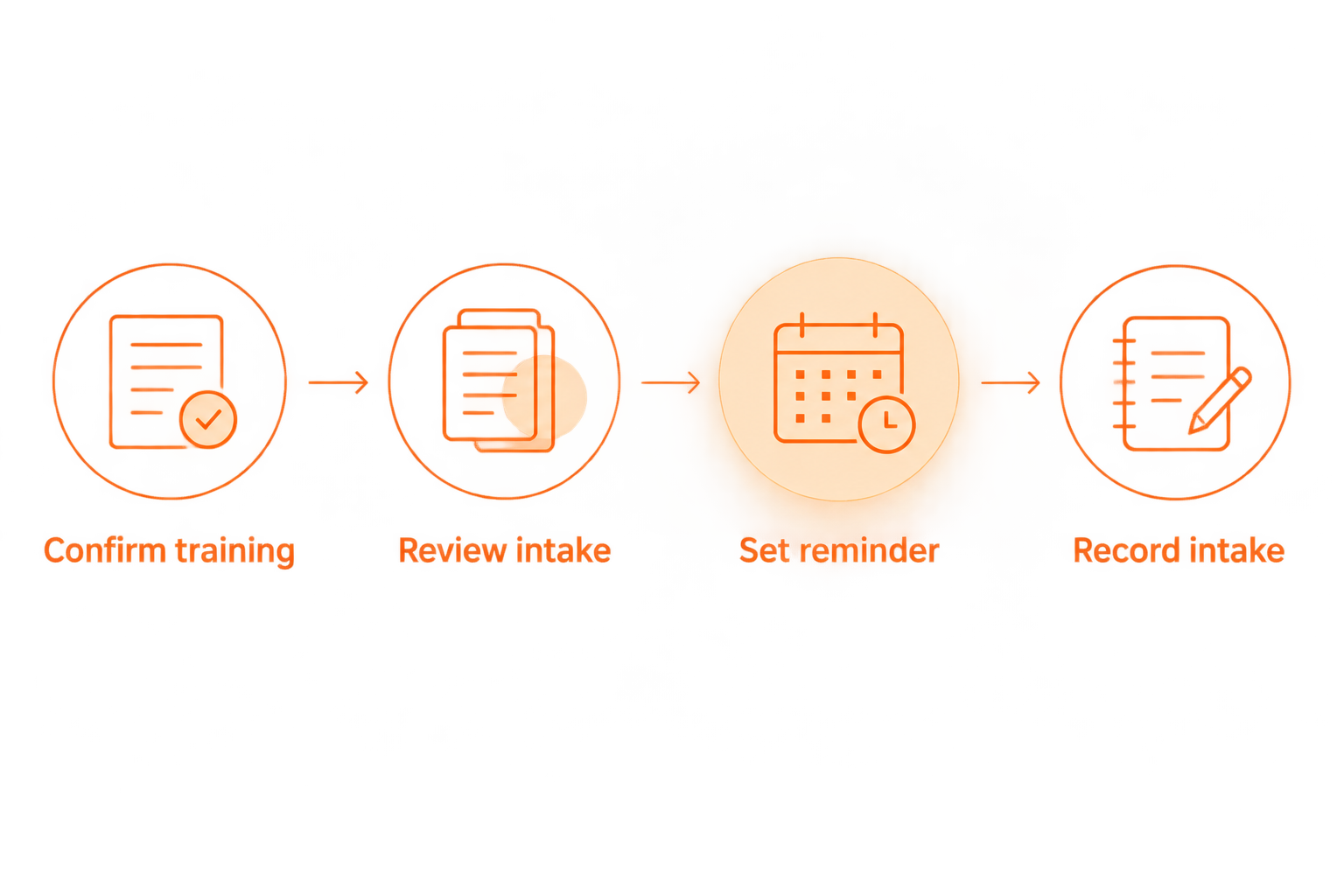
- Confirm training: check that the Freeletics workout is still happening at the planned time.
- Review intake: check your caffeine log and the product’s warnings before consuming anything.
- Set reminder: work backward from exercise start using the product’s stated timing. Write the product and planned serving in the reminder text.
- Record intake: enter the actual time and amount immediately after taking it. Keep that record separate from the planned reminder.
Expected result: your reminder matches the workout, while your intake log records what actually happened.
For example, if your exercise starts at 7:00 a.m. and the product specifically directs intake 30 minutes beforehand, the reminder belongs at 6:30 a.m. Those are example scheduling times, not directions for an unidentified product.
Use plain reminder text such as: Confirm workout, check caffeine, follow label, record intake. There is no need to invent a supplement setting inside Freeletics or depend on a connection between apps.
Session log
The final configuration unit is a small record you can actually maintain. In 2026, a short note that captures intake and sleep is more useful than an elaborate tracker you abandon.
- Record the product, serving, intake time, and actual exercise start.
- Note whether you ate beforehand and whether you experienced stomach discomfort, unusual jitters, or other unwanted effects.
- Record how the session felt and whether falling asleep was harder that night.
- Review comparable workouts before changing your routine. Change one scheduling variable at a time, and stay within label directions.
Expected result: you can distinguish a timing problem from a delayed workout, a different meal, or extra caffeine.
Keep the comparison modest. A faster workout does not prove that a supplement caused the improvement; sleep, pacing, familiarity, and training progress also affect performance.
Do not use stronger sensations as the success metric. Feeling more stimulated is not the same as completing better-quality work. Comfortable training and normal recovery matter more than noticing a dramatic onset.
Evening variant: move training without moving caffeine later
When a Freeletics workout shifts into the evening, rebuild the supplement decision instead of simply dragging the original reminder later. Caffeine can interfere with sleep even when the workout is finished.
- Check your intended bedtime before confirming any stimulant intake.
- Choose a stimulant-free product or no pre-workout if caffeine conflicts with your sleep routine.
- Follow the alternative product’s own directions; do not copy the timing or serving from another formula.
- Record the change so you do not compare a caffeinated morning workout with a stimulant-free evening session as though they were identical.
Expected result: the workout can move without automatically moving caffeine closer to bedtime.
A practical 2026 rule is to make late-session reminders decision prompts rather than consumption prompts. No single cutoff guarantees unaffected sleep, because caffeine sensitivity and clearance vary.
The trade-off is straightforward: a stimulant-free approach avoids caffeine from that product but does not reproduce caffeine’s effects. Training without a supplement is also a complete option, not a failed version of the workflow.
Early-morning variation
If you wake immediately before training, do not shorten sleep just to create a supplement window. Follow the label, adjust the workout schedule when practical, or skip pre-workout.
Keep food tolerance in the log. If taking the product without food repeatedly causes discomfort, stop repeating that setup and review the directions rather than trying to push through the session.
Troubleshooting
The workout gets delayed after intake
Do not take another serving to restart the countdown. Keep the original intake in your daily total, and decide whether you can train comfortably later without additional supplementation.
If the workout is canceled, leave the record intact. The canceled session does not erase the caffeine already consumed.
You feel nothing and want another serving
Do not redose because a sensation is absent. Check the label and your recorded intake; neither tingling nor a sudden energy surge is required to validate a serving.
If you regularly need more stimulation to feel ready, review sleep, recovery, and habitual caffeine use instead of escalating the product.
You get jitters, nausea, or a racing heartbeat
Stop exercising and do not take more stimulants. Seek urgent medical care for chest pain, fainting, severe shortness of breath, or severe or persistent palpitations.
For recurring unwanted effects, stop using the product and discuss it with a clinician. Moving the same serving earlier does not establish that it is appropriate for you.
The reminder repeats on a rest day
Change recurring reminders so they match actual training days, or make every reminder require confirmation. Never take pre-workout simply because an alarm appeared.
Daily-use supplements need their own instructions and tracking. Do not make every supplement follow the pre-workout countdown.
You train well but sleep poorly
Remove late caffeine rather than judging the routine only by workout performance. Check the entire day’s intake, including coffee and energy drinks, before blaming the final serving alone.
A stimulant-free formula or no supplement removes pre-workout caffeine from the experiment. Continue tracking sleep instead of assuming that the change guarantees improvement.
Customize your workflow
Keep the system small: exercise start, product directions, caffeine check, actual intake, and a brief outcome note. Tigerfitness pre-workout shopping should come after those decisions, not replace them.
Once that routine is consistent, add meal timing or hydration notes only when they answer a specific problem. Avoid changing the product, serving, meal, and training time together; you will lose the ability to identify what helped.
Treat your 2026 log as a personal record, not a medical test or a performance study. Bring it to a clinician if symptoms or medication questions arise.
FAQ
How long before a Freeletics workout should I take pre-workout?
Follow your product’s labeled timing before your actual exercise start. Approximately 60 minutes before exercise is commonly used in caffeine research, but that does not establish the ideal timing for every multi-ingredient formula.
Do I need pre-workout for Freeletics?
No, you do not need a pre-workout supplement to complete Freeletics workouts. Use training without it as your baseline, and prioritize sleep, food, hydration, and a manageable workout schedule.
Can I take pre-workout right before starting Freeletics?
Use the timing on your product label rather than assuming immediate intake is equivalent. If your schedule does not leave that interval, adjust the schedule or skip the supplement instead of taking extra.
What should I do if my Freeletics workout moves to the evening?
Reassess stimulant use instead of automatically moving the serving later. A stimulant-free product or no pre-workout avoids adding caffeine from that serving near bedtime.
Can I drink coffee and take pre-workout on the same day?
Count caffeine from both before deciding whether to take pre-workout. The FDA’s 400 mg daily reference for most adults is not a personal target or a guarantee of safety, and individual restrictions take priority.
Should I take another serving if my workout gets delayed?
No, do not take another serving simply because the workout moved. Record the original intake and follow the product’s limits; elapsed waiting time does not erase what you consumed.
Does Tigerfitness have stimulant-free pre-workout options?
Tigerfitness lists HTLT Pre Pump 2.0 and Bucked Up Non-Stimulant Pre-Workout with stimulant-free descriptions. Review each current label for ingredients, directions, and warnings before choosing.
One last thing
The most useful reminder happens before intake: confirm that you are actually going to train. Once a stimulant is consumed, canceling the workout does not cancel its effects. Build that confirmation into the routine before fine-tuning the countdown.
The products and claims discussed are not intended to diagnose, treat, cure, or prevent any disease.
Leave a comment